
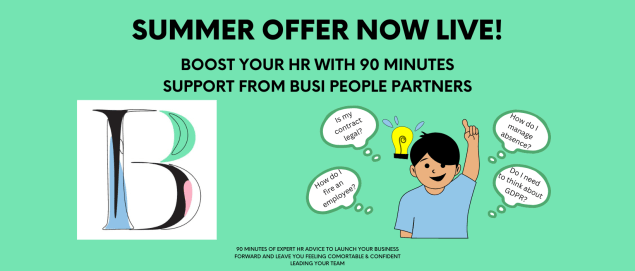
The Summer HR Boost!

As the Summer sun (it’s out there somewhere!) ushers in a season of growth and transformation, so does our exclusive HR Summer Boost offer for small businesses. If you’re a small business owner or entrepreneur looking to hire your first employee or manage a team of up to 20 employees, this limited-time offer is tailor-made for you. Our 90-minute HR workshop is designed to equip you with the strategies, expertise, and confidence needed to elevate your HR practices and propel your business to new heights.

Why HR Summer Boost?

Hiring and managing a workforce can be a daunting task, especially for small businesses with limited resources. HR Summer Boost aims to address these challenges head-on, providing you with a roadmap to optimize your HR processes. Our team of seasoned HR experts will work closely with you to understand your business’s unique needs and craft a customized action plan that aligns with your goals.

Expert Advice and Tailored Strategies

During the HR Summer Boost workshop, you’ll have the opportunity to tap into the vast expertise of our HR consultants. They will offer valuable insights on various HR aspects, including recruitment, onboarding, employee engagement, compliance, and HR policies. With their guidance, you can streamline your hiring process, ensuring you attract top talent that aligns with your company culture. Moreover, you’ll learn effective employee management techniques that foster a productive and motivated workforce.

Increased Confidence as an Employer

One of the most significant benefits of HR Summer Boost is the increased confidence and peace of mind you’ll gain as an employer. Understanding HR best practices and being equipped with a well-defined action plan can significantly boost your confidence when facing HR-related challenges. Whether it’s handling employee relations, implementing performance evaluations, or ensuring compliance with labor laws, you’ll feel better prepared and empowered to make informed decisions that benefit both your employees and your business.

Limited-Time Offer: Act Now!

Time is of the essence! HR Summer Boost is a limited-time offer, and slots are limited. Don’t miss out on this opportunity to supercharge your HR capabilities and set your small business up for long-term success. To secure your spot, simply reach out to us through hello@busipeoplepartners.co.uk, call us on 07778511888 or complete the contact form, and our team will be delighted to assist you.

Unlock Your Business’s Potential

Imagine your small business thriving with a well-structured HR foundation. Picture a team of dedicated and motivated employees working cohesively towards your shared vision. HR Summer Boost is not just a one-time consultation; it’s a gateway to unlocking your business’s potential. Armed with expert advice and a personalized action plan, you’ll be better prepared to navigate HR challenges and focus on what truly matters – growing your business.

Book Now!

This summer, take the leap towards HR excellence with HR Summer Boost. Embrace the opportunity to transform your HR practices and drive your small business towards success. Our 90-minute workshop, led by seasoned HR experts, will provide you with tailored strategies, expert advice, and the confidence to thrive as an employer.

Empower your small business today – book your slot for HR Summer Boost and witness the positive impact it brings to your company’s growth journey. Let this summer be the season of transformation and success for your business!


Employment Contracts

One of the changes coming to employment law from 6 April 2020, is that all employees and workers must have a written statement of terms and conditions from day one of starting work. The law sets out some key information which must be included in this written statement, which are set out below.

Previously only employees were entitled to a written statement within their first two months of work and in reality this often didn’t happen at all.

The MUST haves

The written statement can be made up of more than one document, for example an offer letter and employment contract – regardless of how many documents are used, the ‘principal statement’ must contain the following information:

  • The business’s name and address
  • The employee’s name, job title (or description of work) and start date
  • Continuous service date (if applicable)
  • Rate and frequency of pay
  • Hours of work – be sure to include any overtime or weekend work
  • Holiday entitlement (and if that includes public holidays)
  • Work location(s) & relocation (if applicable)

The following information must also be included, but might not be covered in the principal statement:

  • End date or duration of temporary work
  • Notice periods (from employer and employee)
  • Collective agreements
  • Pensions
  • Grievance process (point of contact and appeal process)

Additional Information

The following information doesn’t need to be described in detail, but you must signpost employees to their location:

  • Sick pay and procedures
  • Disciplinary and dismissal procedures
  • Grievance procedures
  • Other paid leave (inc. family leave)

Are you prepared?

If you’re unsure if your current documents tick all the right boxes, or if you don’t have any set templates (don’t worry we won’t judge!), contact us for a no obligation chat and we can discuss how we can help you meet the new deadlines in a cost effective and proportional way.

Relevant services include: HR Audit, Your First Hire package and on demand support.

So they’re having a baby!

If one of your team is growing their family, there are a number of obligations you have as an employer.

Firstly, it is important to remember the 4 main types of statutory leave employees can be entitled to:

  • Maternity Leave – expectant mothers
  • Adoption Leave – primary adopter / carer
  • Paternity Leave – expectant fathers or secondary carers
  • Shared Parental Leave – Sharing maternity / adoption leave

You probably already thought about Maternity and Paternity, but families are shaped and created in many different ways, as a business owner you might have to support all of them!

Fortunately the basics are the same – be supportive, understanding, empathetic and follow a process!

As soon as an employee tells you they are expecting a new arrival, you can start planning for their leave and considering the support which you may need to provide, as well as your legal obligations.

Once you have figured out the basics;

  • Your pay policy (following statutory minimums)
  • Period of leave
  • Arrangements for cover

You will also need to consider the impact on the employee, from helping them prepare and accommodating any necessary time off for appointments through to keeping in touch while they’re away from the office and finally their reintegration to the business following their leave.

How much detail you need to cover will, of course, depend on how long the employee plans to be away from the office, anywhere from 1 week to 1 year!

To make the process as positive (and easy to manage) as possible, the best thing you can do is get some basic policies and processes in place so when the time comes, you will know exactly what to do.

Busi People Partners can provide support managing family leave, reviewing or creating policies and procedures and providing training to you & your management team.

Take Note!

If there is just one piece of advice all small business owners should follow, it’s this…

Record everything! If its a spreadsheet, an employee notebook or a word file, take note of your conversations, issues and processes! It can save you months in the long-run.

The classic example we experience is an underperforming employee – they’ve been underperforming for a long time but you wanted to give them a chance, and you did. In fact you gave them many chances to improve until the time comes that the rest of the team are frustrated and resentful. You feel you’ve done as much as you can and now you’re ready for a termination conversation.

Maybe at this point, you engage with your HR specialist – the first question we will always ask…

What have you done so far and what evidence do you have to show this?

You may be able to tell us about a lot of conversations you had with your employee, but you’re not sure when they happened or exactly what you said. Unfortunately this often means having to start your performance improvement process all over again and that means the timeline starts over too. Now you’re frustrated, your employee is unhappy and the team might think you’re not managing the situation.

The same issue can happen with disciplinary issues, grievance management, flexible working requests, recruitment and just about any people management process you can think of.

For effective, timely people management taking accurate notes is the foundation you need to hold your business up, not to mention if you ever have to defend your actions in a tribunal setting.

For an easy, integrated solution, speak to us today about our HR system, which not only manages all your employee data but also has the functionality to record meeting minutes and notes in one location.

Managing Performance

Firstly and most importantly Happy New Year! I hope you are all feeling refreshed after a break with family & friends and ready to jump in to a brand new year full of opportunities for success.

I’ve always loved this time of year for reflection on the past 12 months and looking forward to the next, both at home and at work, often in the guise of the dreaded ‘Annual Appraisal’.

What is an Appraisal?

The act of examining someone or something in order to judge their qualities, success or needs.

Cambridge Dictionary Definition, dictionary.cambridge.org

This definition and really just the term ‘annual appraisal’ makes me a little uncomfortable and here’s why:

  • ‘Performance Management’ is not something which should just be done to you. An individual should have active participation in their own performance and development.
  • It should not be an annual activity or even just a scheduled activity, performance management and development is something which should be happening all the time.
  • Having one or two (mid-year and full year) conversations about performance is not enough.

Annual Appraisals Don’t Work

Theres been a lot of media attention over the past few years to the demise of annual appraisals and the emotional strain of performance rating scales for employees and managers. A lot of this research is solid, evidence based and just makes sense.

BUT, I think the message has been a little lost – it does not mean we don’t need to bother with performance management processes, objectives and conversations with our employees. It means we need to frame them differently and actually embed these conversations into every day management.

I recently had a conversation with a business leader at a large corporation who told me ‘we don’t need to bother setting objectives, I’ve read the research and I know Google and Accenture got rid of their appraisal systems, why can’t we?”. My answer was twofold.. firstly Accenture and Google both removed their traditional ratings – yes but neither stopped managing their employees, in fact they both moved to far more regular, less formal management styles, and by the way Google still have a rating scale, they just apply and use it in a different way, twice a year. Lastly and most importantly, do you have confidence that all the leaders and managers across the organisation regularly sit down with their teams and discuss performance? If we removed the annual process, would your employees ever be spoken to about their goals, performance and ambitions? If the answer to this is anything other than “absolutely, of course” then removing all processes probably isn’t what you need, instead think about developing your leaders and fostering a culture where feedback happens every day.

Managing Performance the 2019 Way

If you’re currently creating or have finished your business plan for 2019, share it! There may be some parts you need to keep confidential (if there’s an acquisition in the pipeline or significant change) but on the whole, its great for your team to know where you’re heading and feel that they can and will be part of the journey with you.

In small businesses, its sometimes easy to assume everyone knows everything, but often a team of 5 can all have slightly different snippets of the same picture and end up with a totally different impression. Take an hour out and make sure everyone knows exactly what you hope to achieve this year. You may even uncover some skills and experience in your team to get there faster than you thought.

Once everyone knows which road the business is taking, ask your team to come up with 3-5 ways they can help you get there. Generally, I prefer a quarterly approach to objective setting with maybe 1 or 2 longer reaching goals where relevant. Start off generic but them make them SMART! There’s nothing more frustrating than trying to figure out if someone “learned about finances” at the end of the year.

Once all the objectives are agreed, set up regular (usually 1 – 4 weekly) 121 meetings to review – How’s every day work? How are the objectives going? Are they all still relevant and achievable? Do either of us need more support? Its your chance to say ‘well done’ and ‘thank you’ and also address any concerns as and when they happen – not 6 months later. Don’t forget, the objectives are live and should be adding value and importance almost every day, if they’re not, don’t be afraid to take a fresh look.

If you would like to discuss in more detail, ask a question or are interested in developing a bespoke performance management process for your business, get in touch with us today.

Importance of Holiday

In recognition of my weeks holiday, and that of many workers taking a break for the school half term, it seems like a great time to talk annual leave and holidays. If you run your holiday year from January to December, it’s also a good time to start planning for 2019.

The law

In the UK all employees are entitled to a minimum of 5.6 weeks holiday every year including bank holidays, for most full time workers this means 28 days, pro rata for part time workers. In England and Wales, we usually have 8 bank holidays which for most leaves 20 days to be agreed between you and your team.

Of course, many businesses decide to give their teams more than this and some allow their employees to purchase additional leave or take unpaid leave for time in excess of this. As an employer, you should be seen to encourage your teams to take their annual leave entitlement, and usually this means not offering to pay extra time instead.

Is time off good for business?

In short – yes! Over the past 20 years a lot of research has been conducted around well-being, time off and productivity, some of the benefits of holiday are;

  • Increased productivity
  • Increased creativity
  • Reduced stress levels
  • Reduction in sickness absence
  • Reduced employee turnover

Unfortunately, according to the Glassdoor Annual Leave survey, on average employees will take just 77% of their holiday – based on the minimum thats 6.5 days every year, and without holiday all those benefits can turn into big issues.

How do I ensure the team take holiday?

Following these simple tips can be the beginning of a new attitude to annual leave for your team:

  • Make sure everyone knows their entitlement & how to book
  • Be a role-model, take your holiday too and make sure to tell the team
  • Have a switching-off policy – no emails or office contact during holiday
  • “Use it or lose it” – unless theres an exception, don’t allow carry over leave

Holiday and Other Leave

This is an area which can feel complex and often confusing, if an employee is on long-term sickness absence or family leave – they will continue to accrue and be entitled to holiday during this period. When the leave is planned, in the case of family leave employees can be encouraged to take their holiday before their leave starters. For sickness / unplanned absence, they have the right to carry forward at least 20 days for a minimum 15 months following the end of the leave year.

If this is a situation you are stuck with, give us a call and we can discuss the specifics of the case to come up with a recommended solution.

HR system

I couldn’t finish this guidance without saying all of this is much easier and takes far less involvement if you have a HR system to do it for you! We can provide you with a HR system to calculate entitlements, manage requests and your team calendar with minimal administration and direct access for both employees and managers.

Contact us today to discuss how your process can be improved and say goodbye to admin burdens!